One table model for all three signals
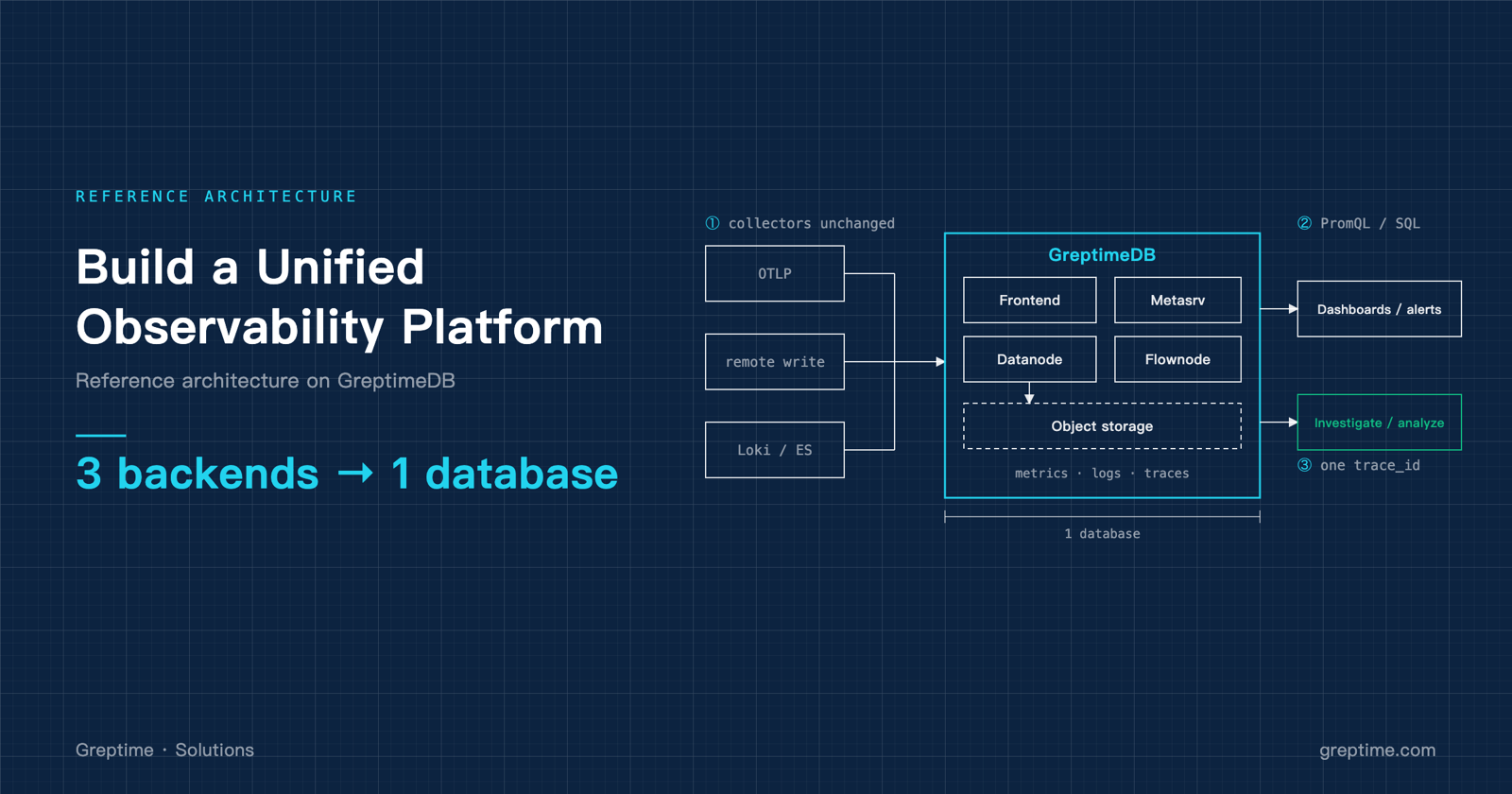
Metrics, logs, and traces share one table model: tags, timestamp, and fields. When the data carries common identifiers such as service, host, or trace ID, you can correlate it in SQL — no ETL between databases.


Integrate GreptimeDB with your preferred technology stack
Installation Guide
Learn more












Metrics, logs, and traces share one table model: tags, timestamp, and fields. When the data carries common identifiers such as service, host, or trace ID, you can correlate it in SQL — no ETL between databases.

Compute-storage disaggregation architecture with object storage (S3, GCS, Azure Blob) as primary storage. Up to 50× lower storage cost through compression and object storage. Memory and local-disk caches keep recent and frequently queried data close to compute.

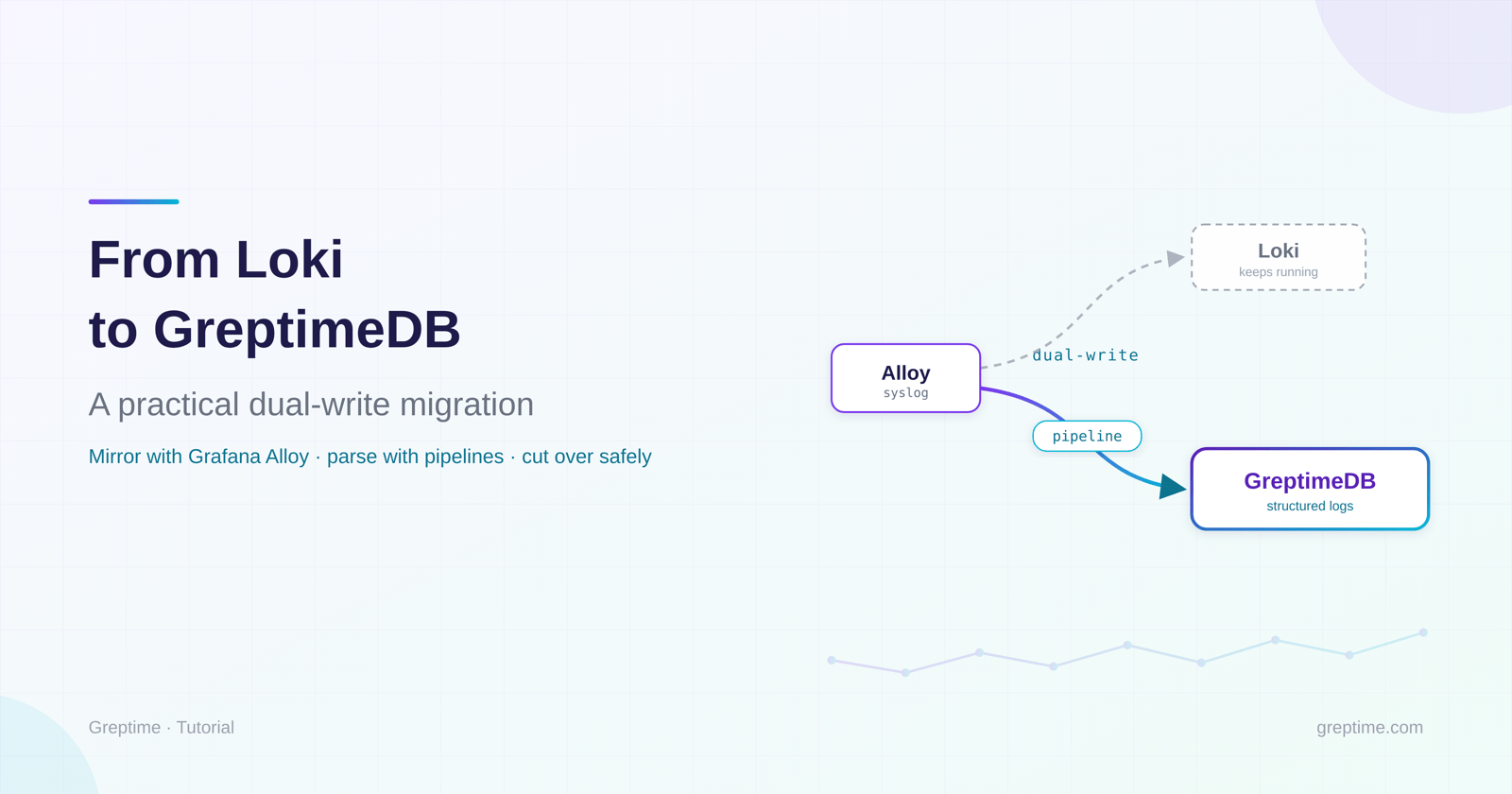
Ingest through OpenTelemetry (OTLP), Prometheus Remote Write, Loki Push, Elasticsearch Bulk, InfluxDB line protocol, and gRPC. Query with SQL across observability data, PromQL for metrics, and the Jaeger query API for traces. Grafana datasource, MySQL and PostgreSQL wire protocols. Migrate ingestion one signal at a time without rebuilding your collectors.

Written in Rust, built on Apache Arrow and DataFusion. Inverted, skipping, and fulltext indexes keep high-cardinality observability data queryable as it grows.

Designed for Kubernetes. Compute and storage are decoupled — compute nodes read shared data from object storage, so you size them separately. No Thanos-style sidecar complexity.

One binary runs on ARM-based edge devices and on cloud clusters with identical APIs. For connected-vehicle and IoT deployments, see the Edge-Cloud solution.
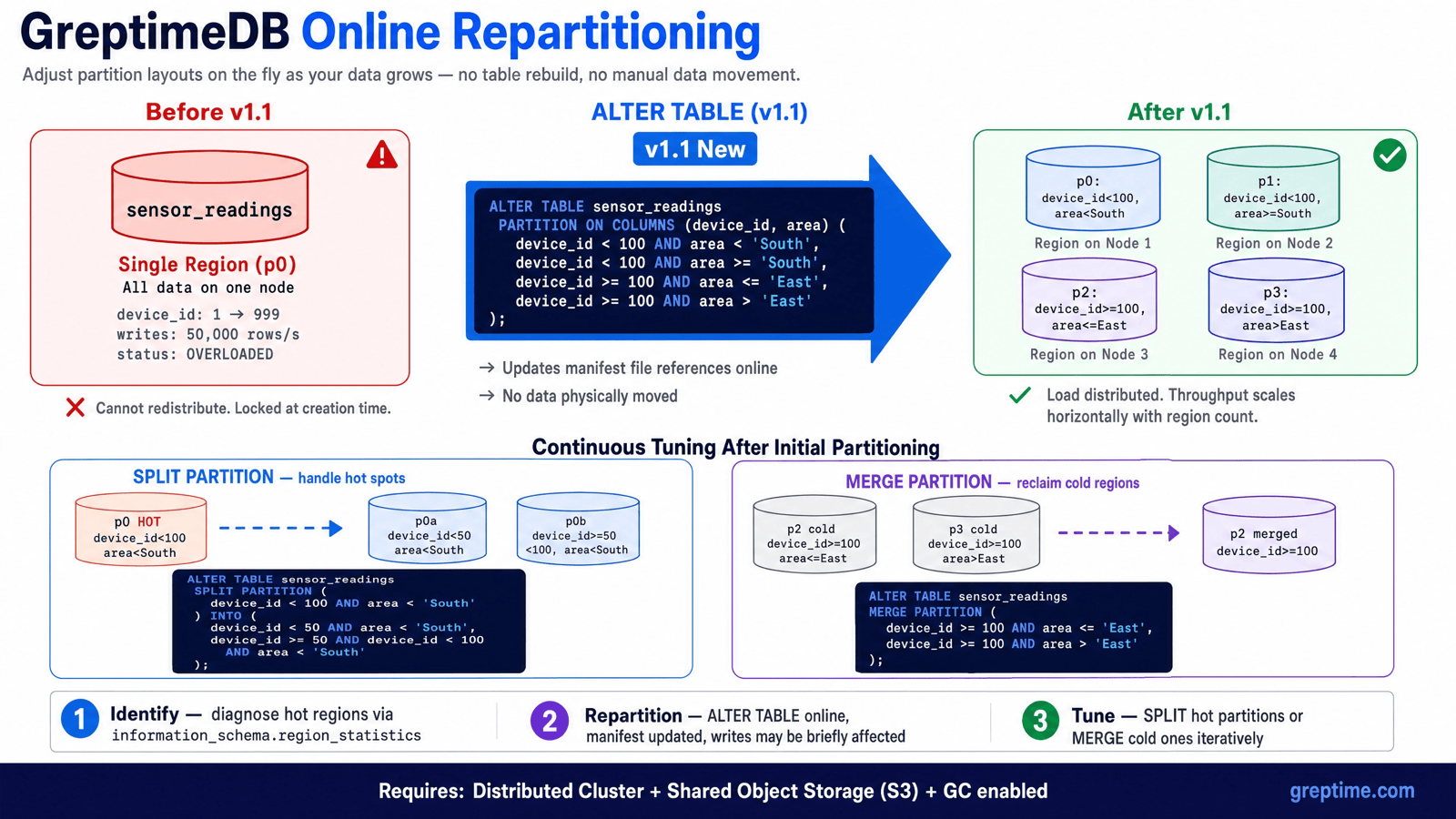
Apache-2.0 licensed core. Repartition and Region migration are manual operations in open source. Enterprise automates them, and adds read replicas, workload isolation, RBAC/LDAP, and audit logging.
Latest Tutorials
Quick answers to common questions about GreptimeDB.
In published benchmarks, GreptimeDB writes about 2× faster than InfluxDB and 2.17× faster than TimescaleDB, with time-range queries up to 67× faster and storage as low as 1/18 the size on the same dataset. For logs, ingestion runs 1.5× faster than Loki and queries 40 to 500× faster; storage lands around 50% of ClickHouse and 12.7% of Elasticsearch. Methodology and full numbers are in the benchmark reports and compare pages.
Yes. GreptimeDB ingests data through OpenTelemetry OTLP, Prometheus Remote Write, Loki Push, and Elasticsearch Bulk, and exposes the Jaeger Query API for traces. All three signals use the same columnar engine and share one table model — tags, timestamp, and fields — so when the data carries common identifiers you can correlate it in a single SQL query without ETL. For details, read Why GreptimeDB and the Integrations Overview.
No. Cluster deployment, object storage, the Flow engine for continuous aggregation, and the ingestion protocols are all in the Apache-2.0 build. Enterprise adds operational and scaling features: read replicas, workload isolation, automated repartitioning and region load balancing, bulk ingestion, LDAP/RBAC and audit logging, the management console, and SLA-backed support. The core engine and its APIs are the same. See the feature comparison.
GreptimeDB runs as a single-binary standalone (Linux, macOS, ARM devices) or as a Kubernetes cluster with compute and storage disaggregated over object stores. The same binary handles a single node or a 100-node cluster. For production storage use S3, GCS, or Azure Blob; for cluster metadata use etcd, MySQL, or PostgreSQL. Setup steps are in the installation guide. For edge-to-cloud deployments, see the Edge-Cloud solution.
Compatibility is per protocol, and query-side coverage is narrower than ingestion:
_bulk ingestion is in the open-source core and accepts inserts only.Per-protocol setup: Ingest Data.
Li Auto runs GreptimeDB on-vehicle across its EV production fleet to capture raw telemetry at the edge and save tens of millions in cloud bandwidth costs (case study). OceanBase Cloud runs 80+ GreptimeDB clusters carrying 300TB+ of logs and SQL audit data, with storage cost down by over 60% after migrating off Grafana Loki (case study). A leading AI company runs a 6,000+ core GreptimeDB cluster holding 40 TB, as the single store for monitoring and log data from its Spark-based data platform. Other industries with public deployments: e-commerce observability, AI infrastructure, industrial IoT. More in Use Cases.
Read replicas, datanode groups, and automated repartitioning
Fully-managed cloud service with auto-optimization
Specialized automotive and IoT integration
Stay in the loop
Get the latest updates and discuss with other users.